














LG Display unveils FLiPP, achieving dream next-generation OLED technology
LG
Display, the world's leading innovator of display technologies, announced that
it has successfully developed a dream OLED patterning method that is free from
the conventional fine metal mask (FMM) process, using its own proprietary
technology. Its groundbreaking FMM-less method delivers much greater
flexibility in mass production as well as brighter panels with longer lifespan
and lower power consumption.
The
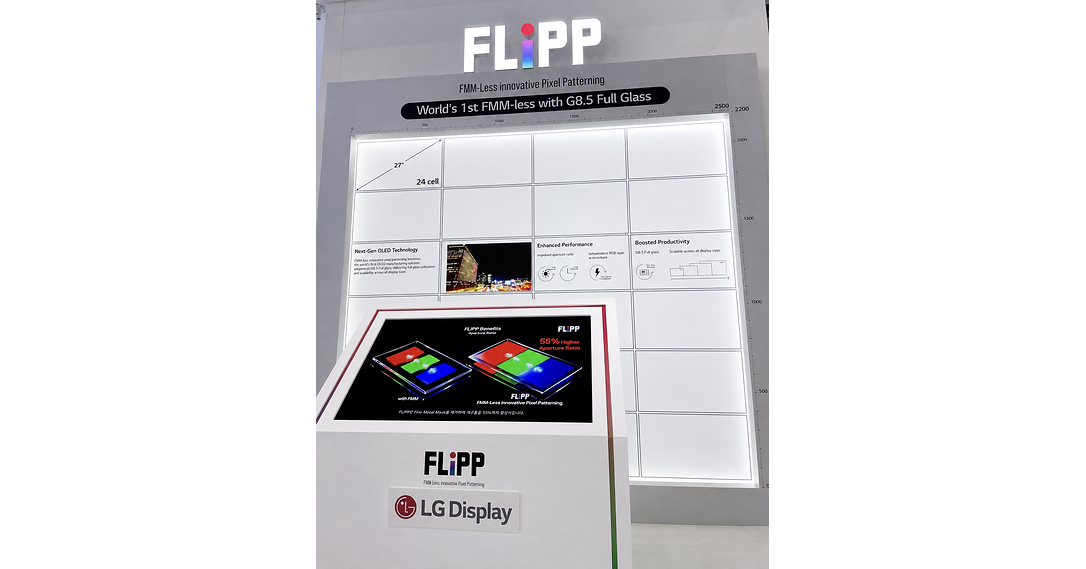
company will unveil FLiPP (FMM-Less innovative Pixel Patterning) for the first
time in the world at the International Meeting on Information Display (IMID)
2026 in Busan, where LG Display will host a dedicated exhibition hall for three
days from Aug. 19.
Compared
with panels produced using FMMs under identical conditions, FLiPP enables
displays to increase brightness by 1.6 times, extend lifespan by 2.4 times, and
reduce power consumption by 13%. This is because FLiPP improves the aperture
ratio — the proportion of the total display area occupied by RGB pixels — by
approximately 55%.
The
FMM method adds to manufacturing costs as expensive new FMMs must be produced
whenever the panel size or resolution changes. In addition, due to the inherent
properties of metal, large masks tend to sag in the center under their own
weight, causing misalignment and sometimes resulting in color-mixing defects.
FLiPP
eliminates the disadvantages associated with the metal plates used in the FMM
process that has been the mainstream OLED manufacturing method for over a
decade. The FMM process requires large mother glass substrates, such as 8.6th-generation or other 8th-generation (2,200 × 2,500
mm) substrates, to be divided and processed as half-cut substrates due to the
limited size of FMM sticks.
After
a year of concentrated R&D, LG Display came up with FLiPP as a new OLED
manufacturing paradigm. Unlike the FMM method, which may be compared to a
stencil art technique where red, green, and blue (RGB) organic materials are evaporated through
tiny holes in metal plates, FLiPP coats RGB pixels in order, secures them
in precise positions, and incorporates photolithography — employing precision
UV light etching to erase unnecessary areas during OLED pixel patterning.
Leveraging
its existing large-sized Tandem WOLED production infrastructure and technical
expertise, FLiPP has allowed LG Display to become the first display company to
manufacture FMM-less OLEDs using 8.5th-generation mother glass
as a single whole piece. Compared to the production of OLED laptop panels of
the same size made using FMMs or other FMM-less methods that require divided
substrates, FLiPP delivers up to 64% higher mother glass utilization
efficiency. As a result, less substrate material is wasted and FLiPP directly
translates into higher productivity and lower manufacturing costs.
As
the world's only FMM-less manufacturing process for 8.5th-generation OLED panels, LG Display has filed trademark
applications for FLiPP in Korea and key global markets.
The
company is strengthening its OLED technology leadership by combining RGB OLED,
widely regarded as the most advanced OLED technology available today, with
FLiPP, its next-generation innovative manufacturing process, to maximize
production flexibility and efficiency.
One
of FLiPP's greatest advantages is that it is free from panel size and
resolution constraints. In theory, it can be used to produce displays ranging
from 1 inch to 100 inches and can be applied not only to conventional panels
but also to VR and AR displays, making it a virtually universal, "ultimate
technology."
Starting
with IT applications such as tablets and monitors, it will expand its range of
FLiPP-manufactured panels to cover a range of products from 1-inch wearable
devices to ultra-large TVs — tailoring products to customer needs.
"We
were able to successfully realize FLiPP, a next-generation OLED patterning
technology referred to as a 'dream technology,' by bringing together our
proprietary WOLED technologies and know-how," said Choi Young-seok, CTO at
LG Display. "Through our participation in IMID, we will lead
next-generation OLED technologies and accelerate market differentiation."
Meanwhile,
LG Display's next-generation OLED TV panel driving technology, Hyper Double
Scanning (HDS), has been recognized for its technological excellence by winning
the IMID "Display of the Year Award." The award is presented to the
most outstanding product among those commercialized each year. LG Display is
currently mass-producing its entire lineup of OLED TV panels with HDS and plans
to continue leading the global premium TV panel market.
Leave A Comment