



















Toshiba Starts Shipping Engineering Samples of TXZ+ Family Entry Class M4V Group
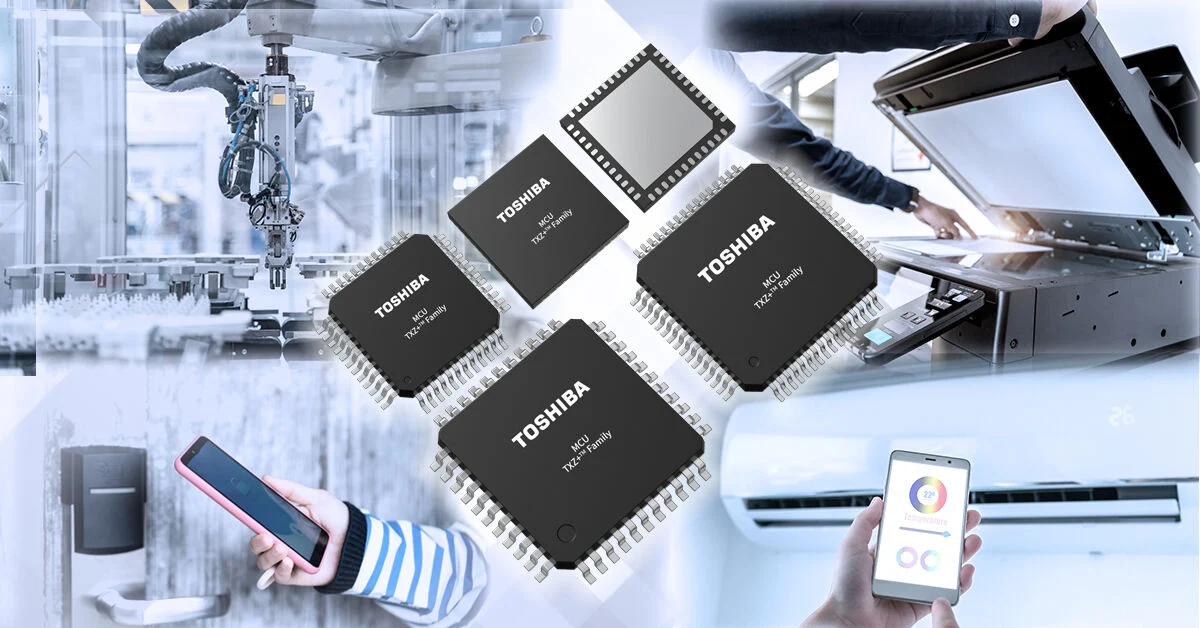
Toshiba Electronic Devices & Storage Corporation (“Toshiba”) has announced TXZ+™ Family Entry-Class M4V Group, standard microcontrollers[1] featuring an Arm® Cortex®-M4 core with a
floating-point unit (FPU), that enhance security and data management in IoT
devices and industrial equipment. Engineering samples are available.
The
widespread adoption of network connectivity and over-the-air updates in
consumer and industrial equipment has improved convenience in respect of remote
monitoring, control, maintenance and device updating, while underlining the
importance of security measures against unauthorized access and program
tampering. There is also growing demand for protection of software assets,
management of configuration and log data, and stable system operation
throughout the entire product lifecycle—from development through to
end-of-life.
Toshiba has addressed these requirements by developing the
M4V Group, which enhances security and data management functions while
retaining the ease of use and versatility of its current standard
microcontrollers. The new products have a multilayered security architecture[2] that combines access control,
memory protection, and execution control functions, which improves overall
system security against unauthorized access and program tampering.
The microcontrollers are built around an Arm® Cortex®‑M4
core with FPU and operate at frequencies up to 80MHz. They deliver the
computational performance and real-time capability required for system control
applications and support a wide range of control applications in consumer and
industrial equipment.
As
on-chip memory, they integrate 128KB of code flash memory, 64KB of data
flashmemory, and 32KB of RAM. The data flash memory can retain rewritable data
such as configuration and log data, securing data management tailored to the
operating conditions of the equipment. The products also support a supply
voltage range of 2.7V to 5.5V and integrate a high-speed oscillator that is ±1%
accurate, which help to reduce external components and improve design
flexibility. The microcontrollers are also suitable for consumer and industrial
equipment with 5V power supplies.
Essential peripheral functions for system control built
into the microcontrollers include a 12-bit analog-to-digital converter (ADC),
timers, a universal asynchronous receiver/transmitter (UART), a serial
peripheral interface (SPI), an inter-integrated circuit (I²C[3]), and direct memory access (DMA). They
also integrate an advanced programmable motor control circuit 2 (A-PMD2[4]) that supports brushless DC motor
control, providing flexibility for a wide range of application requirements and
system configurations. On top of this, they also incorporate a serial memory
interface (SMIF) for connection to external serial flash memory. They support
direct access by mapping external memory into the address space and enable
high-speed memory access with low CPU load through hardware control. This
supports storage of large-volume data, log data, and firmware, contributing to
efficient datamanagement in IoT devices and OTA-enabled systems.
Toshiba
supports device evaluation and development by providing a development
environment in addition to engineering samples. It offers starter kits, sample
software, common microcontroller software interface standard (CMSIS[5])-compliant drivers, and support for
major integrated development environments (IDEs), enabling smooth progress from
initial evaluation to application development.
Toshiba will continue to expand its enablement resources
and related documentation to support safe and flexible system design for
customers, while further strengthening its lineup of microcontroller products
to meet diverse market needs.
Leave A Comment