



























Africans are increasingly online, but awareness and practice of digital safety remain low: Report
Most adults across seven African countries access the Internet
frequently, but many remain unfamiliar with digital security measures and
practice them inconsistently if at all, an Afrobarometer telephone survey shows.
On average across Angola, Benin, Côte d’Ivoire,
Kenya, Nigeria, Senegal, and Tanzania, a majority of respondents say they worry
about the security of their personal data online and believe their mobile
phones are the most vulnerable devices to digital threats. Many respondents are
unaware of online protection tools, and few apply online safety tools and
practices, especially those that provide stronger protection, such as
two-factor authentication, VPNs, and antivirus software.
Respondents tend to rely heavily on informal
sources, such as social media and friends or family, for guidance on digital
safety, while more structured resources – such as workplace training or online
tutorials – are less frequently used.
Though limited to seven countries and respondents
over age 17, these findings highlight significant gaps in digital literacy and
suggest a need for targeted education and accessible resources to ensure that
Africa’s growing digital footprint is both empowering and secure.
Key findings​
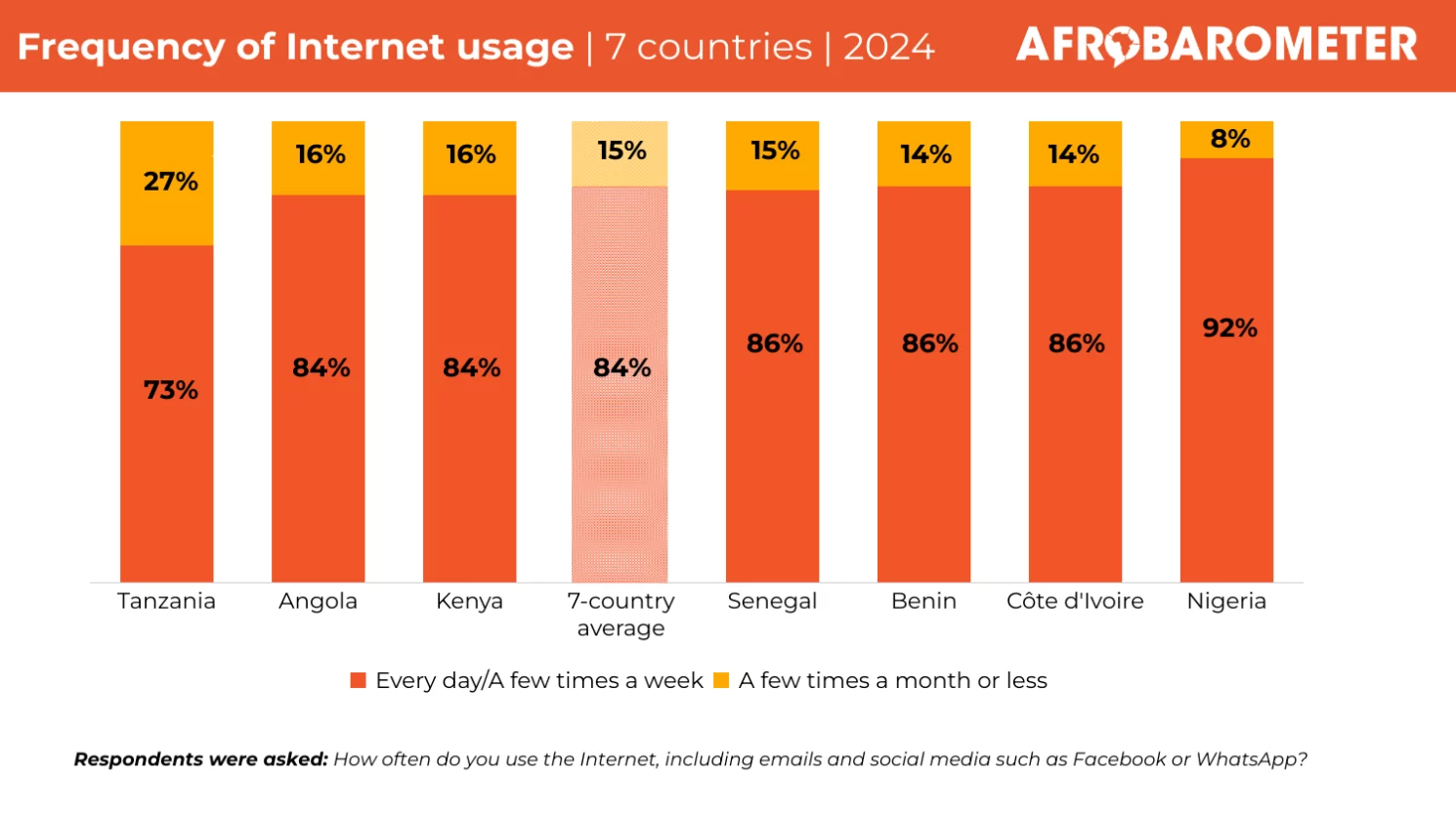
- On average across the seven surveyed
countries, among adults who access Internet content, a vast majority (84%)
say they do so “every day†or “a few times a week.â€
- Mobile phones are the primary mechanism for
accessing the Internet (85%).
- Young adults (aged 18-35) are more likely to
be regular Internet users (87%) than older cohorts (74%-83%).
- More than eight in 10 respondents (82%) say
they get news “every day†or “a few times a week†from social media
platforms . In addition, half (51%)
say they get news regularly from other Internet sites.
- More than half (52%) express concern about the
security of their personal information online, and 81% think mobile phones
are more vulnerable to harmful online activities than computers and other
devices.
- Only about one-third (32%) of respondents
consider themselves “somewhat†(22%) or “very†(10%) familiar with tools
and skills they can use to protect their digital privacy and information.
- Use of protective tools and practices by
Internet users is highly variable (Figure 5):
- More than seven in 10 (72%) say they use
strong passwords to protect their online information, though only about
half (52%) of Beninese make that claim.
- Other security measures are much less commonly
used, including two-factor authentication (33%), antivirus software (30%),
and virtual private networks (VPNs) (21%).
- Most respondents rely on friends and family
(62%) and/or social media (60%) to learn about online safety tools.
- Fewer than half turn to online
videos/tutorials (48%), news articles/websites (32%), and the workplace
(29%) as sources of information about online safety.
Leave A Comment